Hand someone your wallet address and you have handed them your bank statement.
That is not a figure of speech. In banking, a supplier who has your account number learns your account number. They cannot see your balance, they cannot see who else you pay, and they cannot see what you paid them last year. On a public chain the address is the statement: permanent, searchable, and open to everyone, forever.
Most teams discover this the same way. They pay one contractor, and a week later someone mentions a number they should not have known.
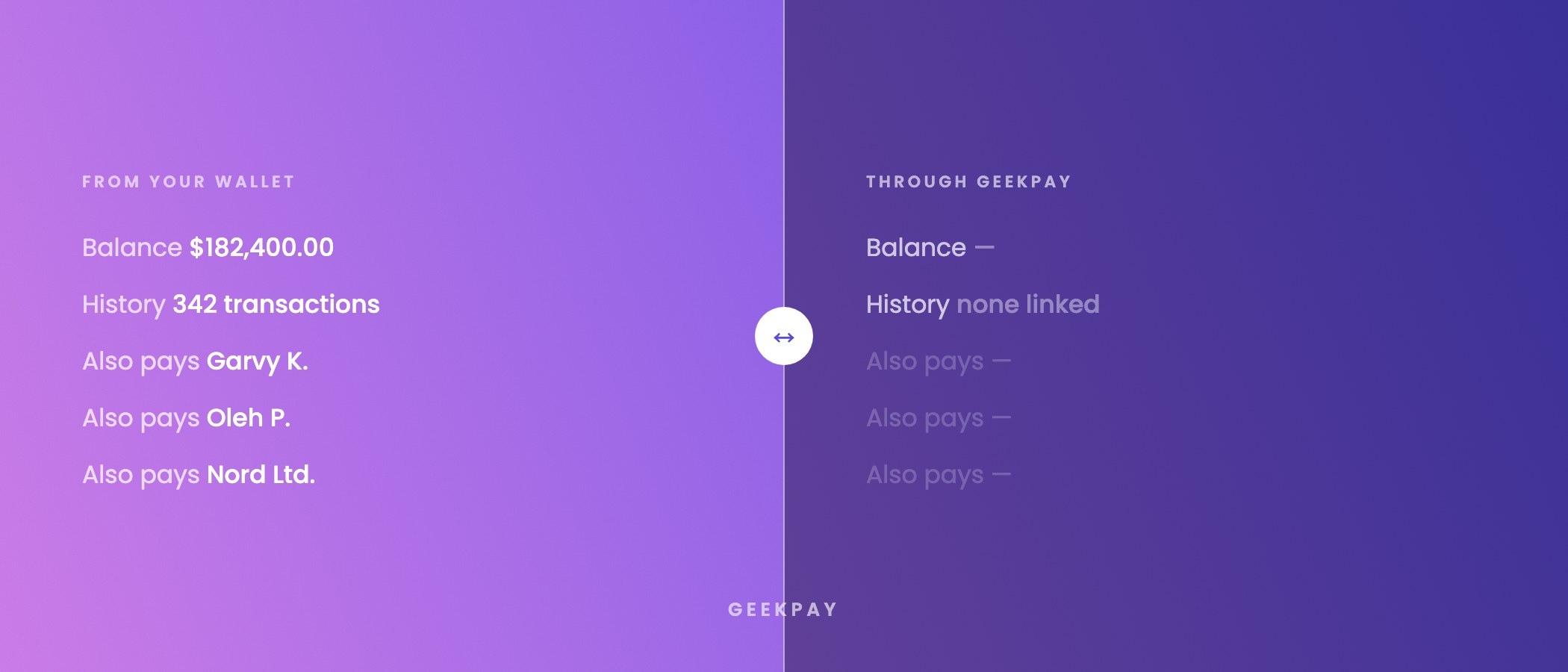
Pay one person from your company wallet. From that single address, they can now see your balance, every payment you have ever sent with amounts and dates, the addresses on the other end and how often you pay each one, and what came in and from whom.
Put a name to two or three of those addresses — and people are not hard to name — and the rest of the picture fills itself in. That is your payroll, your runway, your client list and your supplier terms, reconstructed from one address by one person with a block explorer and two minutes.
It is also retroactive and permanent. The day you share an address you share everything that address has ever done, and everything it will do afterwards. There is no taking it back.
These get conflated constantly, and the difference is the entire point.
Anonymous means nobody knows who you are. That is not what a company wants, and for most of them it is not legal.
Confidential means the people in the transaction know exactly who they are dealing with, and the rest of the world does not get a copy. Your counterparty knows you. Your accountant knows. Your auditor knows. A stranger with one address does not.
That is the normal condition of every other payment you make. Nobody considers it evasive that the person you buy coffee from cannot see your mortgage.
Two things have to be true at once. Removing the address is not enough on its own, and neither is routing.
A Paytag is a permanent public handle at your name — people pay that, not a 40-character string. A Check is a link: you commit the funds, the recipient claims and chooses where it lands, so you never learn their address and they never learn yours. Invoices and Checkout work the same way. The address stops being the thing you exchange.
Payments route through GeekPay’s settlement rail. What lands on chain is a transfer from a shared settlement address to your recipient — not a transfer from you to your recipient.
So the recipient sees the payment, the amount, and that it came from you, because you are named inside GeekPay and you are the one who sent it. Someone inspecting that transaction on chain sees a payment from an address shared by many users: a balance that is not yours, a history that is not yours, and no thread back to anything else you have done.
They see the payment. They do not see your wallet.
Worth being explicit, because it is the question people ask next: this is non-custodial. GeekPay never takes ownership of your funds and cannot move them on its own.
Confidentiality of this kind is not a loophole, and the structure is not unusual.
Both sides of every payment know who the other is. Every payment carries a category, a note and a record of who approved it, and that record exports — so the question “what was this one?” has an answer next quarter, which is more than can be said for a spreadsheet of addresses.
Structurally it is how card payments have always worked. A merchant’s bank statement shows the acquirer, not the bank account of every shopper who bought something. Nobody files that under evasion; it is simply what a payment processor is.
The distinction that matters is purpose. A mixer exists to sever the link between sender and recipient so that nobody — including the recipient — can establish who paid. A settlement account exists so that a processor can settle payments. The counterparty relationship is preserved at every step, and so is the record.
Worth saying plainly, because privacy claims attract more faith than they deserve.
It does not hide the payment from the person you paid. They know. That is the point.
It does not make the chain blank. Settlement transactions exist, with amounts and timestamps, and anyone determined enough can study them.
It does not follow you off the rail. If you withdraw to an address you also use publicly somewhere else, you have linked those two things yourself. Confidentiality covers the payment; it cannot cover what you do with the money afterwards.
And it is not a shield from lawful disclosure, which is the same answer your bank would give you.
Anyone whose payment history is commercially sensitive, which is nearly every company and very few individuals.
If you run payroll, your staff costs are your most sensitive number and you are currently publishing them. If you invoice clients, your rates are visible to every client who compares notes. If you take payments on a public Paytag or a public page, the address is already out there. And if you hold a treasury, your balance is a negotiating position you did not agree to disclose.
If you send one payment a quarter from a wallet nobody knows about, none of this is urgent. It becomes urgent the moment payments become routine.
Send yourself a Check, or point a Paytag at your own account and pay it from an outside wallet. Then look the transaction up on a block explorer and see what is actually there. It takes a couple of minutes and it is more convincing than this article — start at app.geekpay.co.
What your wallet address tells everyone, what confidential settlement actually hides, and why none of it gets in the way of your accountant.

